

Why Repair is the New Replace
Replacing shoe sole components has become the smart choice for shoe lovers who refuse to let their favorite footwear end up in landfills. Whether you’re dealing with a detached sole, small cracks, or worn-out treads, you have two main options:
Quick Answer for Replacing Shoe Soles:
- DIY Repairs: Use shoe adhesives like Shoe Goo or E6000 for minor fixes ($10-50)
- Professional Service: Full sole replacement by expert cobblers ($35-150)
- Best Candidates: Boots, dress shoes, and quality footwear worth saving
- Process: Clean surfaces → Apply adhesive → Clamp for 24 hours → Trim excess
Your worn-out soles don’t mean it’s time to say goodbye to those beloved boots or dress shoes. As one shoe repair expert puts it: “Damaged soles are often easily repaired with a few simple tools and a bit of patience.”
The numbers tell a compelling story: Professional shoe repair services have restored over 5 million pairs since 1994, proving that quality footwear deserves a second chance. More importantly, choosing repair over replacement reduces waste and saves money – a win for both your wallet and the planet.
Three main factors make sole replacement worthwhile:
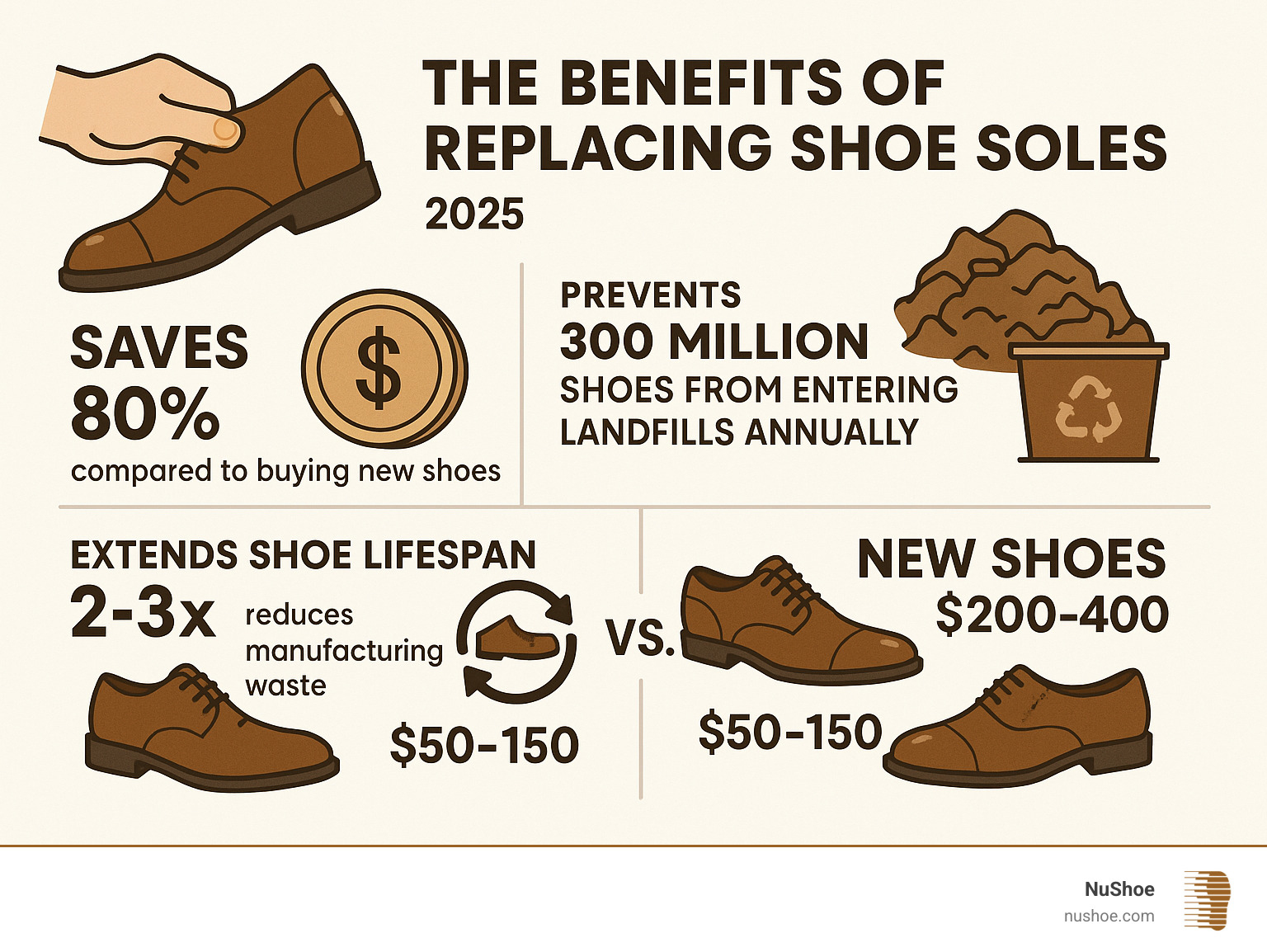
- Cost savings – Repair costs $35-150 vs. $100-500+ for new quality shoes
- Environmental impact – Keeps footwear out of landfills
- Performance – Restored shoes often feel more comfortable than when new
I’m Eric Neuner, founder of NuShoe Inc, and I’ve been helping people restore their favorite footwear since 1994 through both consumer mail-order services and partnerships with major brands. My experience replacing shoe sole components has shown me that most quality footwear can get a genuine second life with the right approach and materials.
Essential replacing shoe sole terms:
Why and When to Repair Your Shoe Soles
We’ve all experienced that moment of dread when we look down and notice our favorite shoes showing serious wear on the soles. It’s heartbreaking, especially when the rest of the shoe still looks great. But here’s the good news: sole damage doesn’t mean game over for your beloved footwear.
Your shoe soles take an incredible beating every single day. They endure thousands of steps, rough pavement, puddles, and everything else life throws at them. Naturally, they’re often the first part of a shoe to show their age. Understanding what’s happening to your soles – and when to act – can save you money and keep quality footwear out of landfills.
The most common culprits behind sole damage include delamination, where the sole starts peeling away from the upper shoe due to adhesive breakdown from age or moisture. You’ll also see cracks developing over time, especially with repeated bending and weather exposure. Punctures from stepping on sharp objects create holes that compromise protection, while uneven wear from our natural walking patterns creates uncomfortable, lopsided surfaces.
Sometimes it’s simply general wear and tear – the treads disappear, material thins out, and cushioning loses its bounce. When any of these issues arise, you’re faced with a choice: toss the shoes or give them new life through repair.
Choosing repair over replacement isn’t just about saving money (though you definitely will). It’s about embracing sustainability and contributing to a circular economy. Every pair of shoes we repair at NuShoe is one less pair heading to a landfill. Since 1994, we’ve kept over 5 million pairs of shoes in circulation, reducing waste while restoring comfort and performance.
Common Types of Shoes for Sole Repair
After nearly three decades in the business, we’ve learned that certain types of footwear are absolutely perfect candidates for replacing shoe sole components. Quality construction and durable uppers make these shoes worth the investment in repair.
Hiking boots are natural candidates for sole replacement. These workhorses are built to handle rugged terrain, and their Vibram outsoles can be refreshed with new aggressive tread patterns perfect for challenging trails. The robust construction of quality hiking boots means the uppers often outlast multiple sole replacements.
Work boots represent another excellent category for sole repair. Safety and durability are non-negotiable in work environments, making professional resoling both cost-effective and crucial for protection. Whether you need thick rubber soles for traction or specialized soles for specific industrial requirements, professional repair ensures your boots meet safety standards.
Dress shoes, particularly those with traditional construction methods, are designed with resoling in mind. Classic leather dress shoes maintain their neat appearance through multiple sole replacements, making them a smart long-term investment.
Goodyear-welted footwear deserves special mention because this construction method – found in premium boots and dress shoes from brands we service – allows for easy sole removal and replacement without damaging the upper. The stitched construction (rather than just glued) means these shoes can be resoled multiple times throughout their lifetime.
Even high-quality sneakers can benefit from sole repair, especially when the upper remains in excellent condition. While many athletic shoes use cemented construction, skilled cobblers can often work magic on quality sneakers, extending their life significantly.
Our expert cobblers can work with virtually any shoe type, tailoring the repair approach to your individual needs and usage patterns.
Assessing the Damage: Repair or Full Replacement?
Before diving into any repair project, take a moment to properly assess what you’re dealing with. Not all sole damage requires the same approach, and understanding the difference can save you time, money, and frustration.
Partial detachment – where just the toe or heel section starts peeling away – is often a straightforward fix with the right adhesive. Address this quickly though, as walking on detached soles is uncomfortable and can lead to further damage or injury.
Small cracks and loose edges respond well to flexible shoe repair adhesives. The key is catching them early, before they spread into larger problems that require more extensive intervention.
When you notice worn tread that’s affecting traction but the sole structure remains sound, you might need anything from a protective sole guard to a half-sole replacement. However, extensive or uneven wear patterns often signal the need for complete replacing shoe sole work.
Crumbling material presents a clear case for professional intervention. When sole material becomes brittle, cracks extensively, or starts breaking apart (especially common with older EVA midsoles), only a full sole replacement will restore proper function and comfort.
The most critical factor in any repair decision is assessing the structural integrity of the upper shoe. Before investing in sole work, carefully examine the leather, fabric, stitching, and internal structure. Cracked leather beyond repair, torn fabric, or compromised internal structure means even perfect sole work won’t create a durable result.
We always recommend checking both shoes in a pair to ensure even wear patterns and that uppers aren’t separating. When the upper portion remains sound, replacing shoe sole components becomes a smart investment that can restore your shoes to better-than-new condition.
For complex damage or complete sole replacement, our skilled team at NuShoe has the expertise and equipment to handle even the most challenging restoration projects.
DIY vs. Professional Repair: Choosing Your Path
Picture this: you’re staring at your favorite pair of boots with a sole that’s starting to peel away from the upper. Your heart sinks a little, but then you remember – this doesn’t have to be the end of the story. You’ve got two paths ahead of you, and choosing the right one can mean the difference between a quick fix and a lasting solution.
DIY repairs offer immediate satisfaction and keep costs low. For around $10-$50 in materials, you can tackle minor issues like small detachments or tiny punctures right at your kitchen table. There’s something deeply satisfying about bringing your shoes back to life with your own hands, and you’ll have them back on your feet within 24 hours.
But here’s the reality check: DIY work requires patience, steady hands, and realistic expectations. Your repair might not look as seamless as you’d hoped, and without professional-grade materials and techniques, the fix might only last a few months instead of years. For complex replacing shoe sole jobs, you could end up making the problem worse.
Professional cobbler services bring decades of expertise to your footwear. At NuShoe, we’ve perfected our craft over nearly 30 years, restoring over 5 million pairs since 1994. Our cobblers use industrial-grade adhesives and specialized equipment that simply aren’t available to home repair enthusiasts.
When you choose professional repair, you’re investing in durability. A properly executed replacing shoe sole service can make your footwear feel better than new, often lasting for years with proper care. Our mail-in repair services make it convenient – just pack up your shoes and send them our way.
The investment ranges from $35-$150 depending on the complexity and materials needed, but consider this: that’s often less than half the cost of quality replacement footwear.
So how do you decide? Think about your comfort level with hands-on projects and the value of your shoes. A quick DIY fix might work perfectly for minor detachments or small cracks on everyday sneakers. But for full sole replacements, especially on quality boots or dress shoes, professional expertise typically delivers better long-term results.
High-value footwear – whether expensive, sentimental, or made with premium construction like Goodyear welting – almost always benefits from professional attention. The specialized tools and techniques required for complex repairs simply aren’t practical for most home workshops.
| Factor | DIY Shoe Repair | Professional Shoe Repair |
|---|---|---|
| Cost | Low ($10-$50 for materials) | Moderate to High ($35-$150+) |
| Durability | Varies; often less durable than professional | High; uses industrial-grade materials and techniques |
| Skill Level | Basic to intermediate | High; requires specialized training and experience |
| Best Use Cases | Minor detachments, small cracks, temporary fixes | Full sole replacement, complex repairs, high-value shoes |
The bottom line? Both paths have their place in shoe care. Start with honest assessment of the damage and your own capabilities, then choose the approach that gives your favorite footwear the best chance at a long, comfortable second life.
Your DIY Guide for Replacing Shoe Sole Components
Sometimes your favorite shoes just need a little TLC to get back on their feet. When you’re dealing with minor sole issues that don’t require a trip to a professional cobbler, rolling up your sleeves for a DIY repair can be surprisingly rewarding. The goal here isn’t perfection – it’s giving your beloved footwear a fighting chance at a longer life.
Before we dive in, let’s talk safety. Always work in a well-ventilated area because shoe adhesives can be pretty potent. Trust me, your lungs will thank you later. And please, protect your work surfaces with newspaper or cardboard unless you want permanent reminders of your repair project on your kitchen table.
Essential Tools and Materials for DIY Repair
Think of replacing shoe sole components as a small construction project – you need the right tools for the job. Having everything ready before you start makes the difference between a smooth repair and a frustrating mess.
Your adhesive choice is absolutely crucial here. Shoe Goo remains the gold standard for most DIY repairs – it’s flexible, strong, and forgiving if you’re not perfect with application. E6000 brings industrial-strength holding power that’s perfect for heavy-duty fixes. For full sole reattachment jobs, contact cement works beautifully because it bonds instantly once both surfaces are properly prepared.
You’ll also need a utility knife for trimming away old material, pliers for pulling off stubborn sole sections, and 120-grit sandpaper to roughen surfaces for better adhesion. Don’t skip the sandpaper – smooth surfaces and shoe glue are not friends.
Isopropyl alcohol (70% or less) is your cleaning champion, though acetone works great for stubborn old glue residue. For securing your repair while it cures, gather up clamps, rubber bands, or even duct tape – whatever keeps steady pressure on the repair area.
A few extras make life easier: cotton swabs for precise adhesive application, a heat gun or hair dryer to soften stubborn old adhesive, and disposable gloves to keep your hands clean. Some weights can be handy when clamps won’t work, and petroleum jelly helps smooth repairs without everything sticking to your tools.
How to Reattach a Detached or Peeling Sole
A peeling sole is like a loose tooth – annoying, but totally fixable with the right approach. This is probably the most common repair we see people tackle at home, and honestly, it’s very doable.
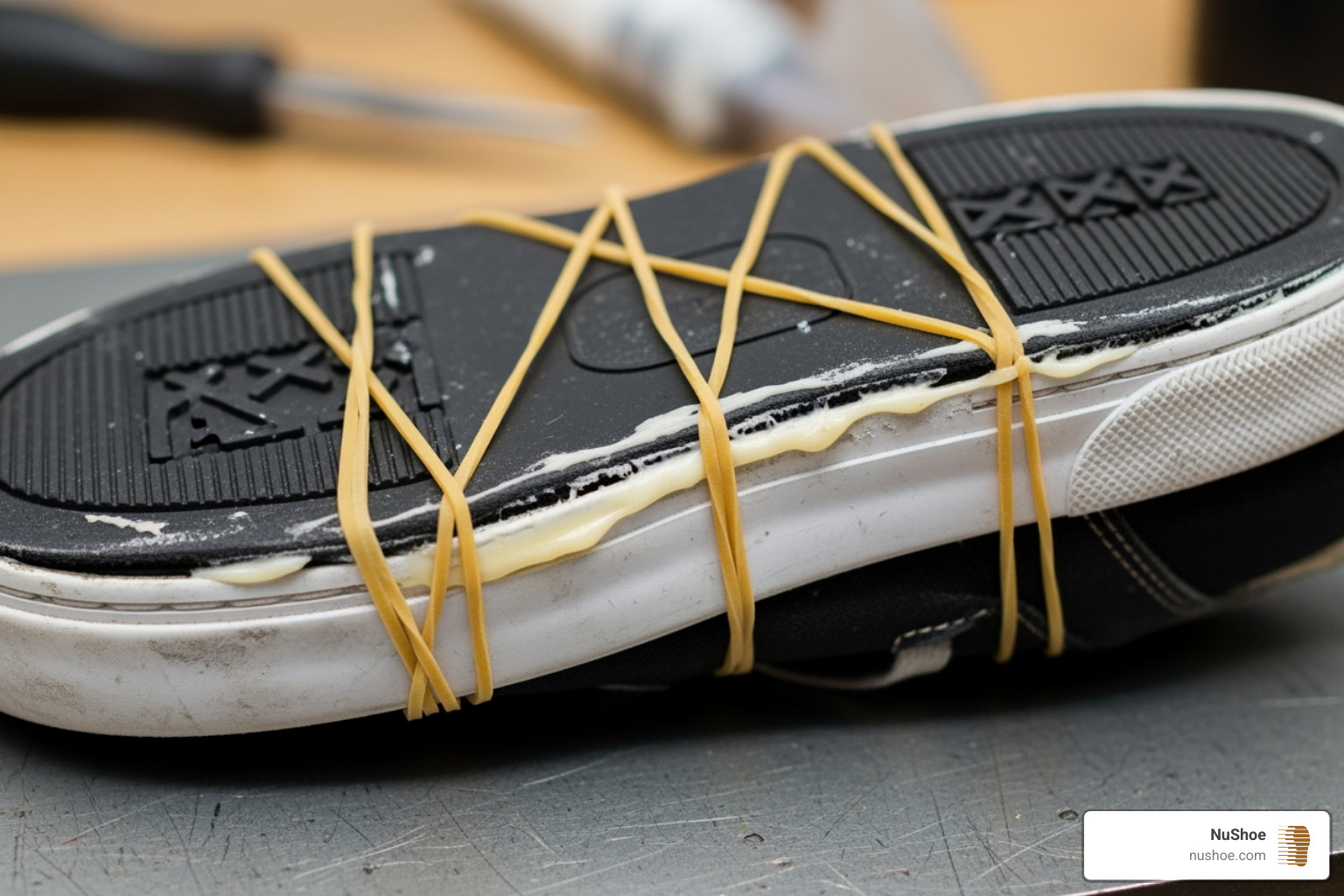
Step 1: Cleaning starts everything off right. Get aggressive with dirt and debris removal using a stiff brush, then wipe both the detached sole and the shoe upper with isopropyl alcohol. If you’re dealing with old glue residue, acetone on a cotton swab works wonders. Make sure everything is bone dry before moving forward – any moisture will sabotage your repair.
Step 2: Roughening surfaces might feel counterintuitive, but it’s essential. Take that 120-grit sandpaper and gently sand both the sole surface and where it’ll reattach on the shoe. You’re creating tiny grooves that give the adhesive something to grab onto. Think of it like giving your glue little footholds.
Step 3: Applying adhesive requires a steady hand and patience. Apply a thin, even layer to both surfaces. With contact cement, you’ll apply to both sides and wait until it’s tacky (not wet to the touch) before pressing together. For adhesives like Shoe Goo, apply and press immediately. It’s better to have slightly too much than too little – you can always trim excess later.
Step 4: Clamping and curing is where your patience gets tested. Carefully align the sole, press firmly, then secure with clamps, rubber bands, or whatever keeps constant pressure across the entire repair. The magic happens during the next 24 hours as the adhesive cures. I know waiting is hard, but rushing this step ruins everything.
For additional guidance, check out a guide to mending shoes for visual tips that complement these steps.
How to Fix Minor Cracks and Punctures
Small cracks and punctures are like tiny leaks in a boat – they seem minor until you’re walking through a puddle. The good news? They’re often the easiest repairs to tackle successfully.
Start with the same thorough cleaning routine using isopropyl alcohol. For punctures, here’s a pro tip: place duct tape on the inside of the shoe over the hole as a temporary backing. This prevents your filler from disappearing into the shoe’s interior.
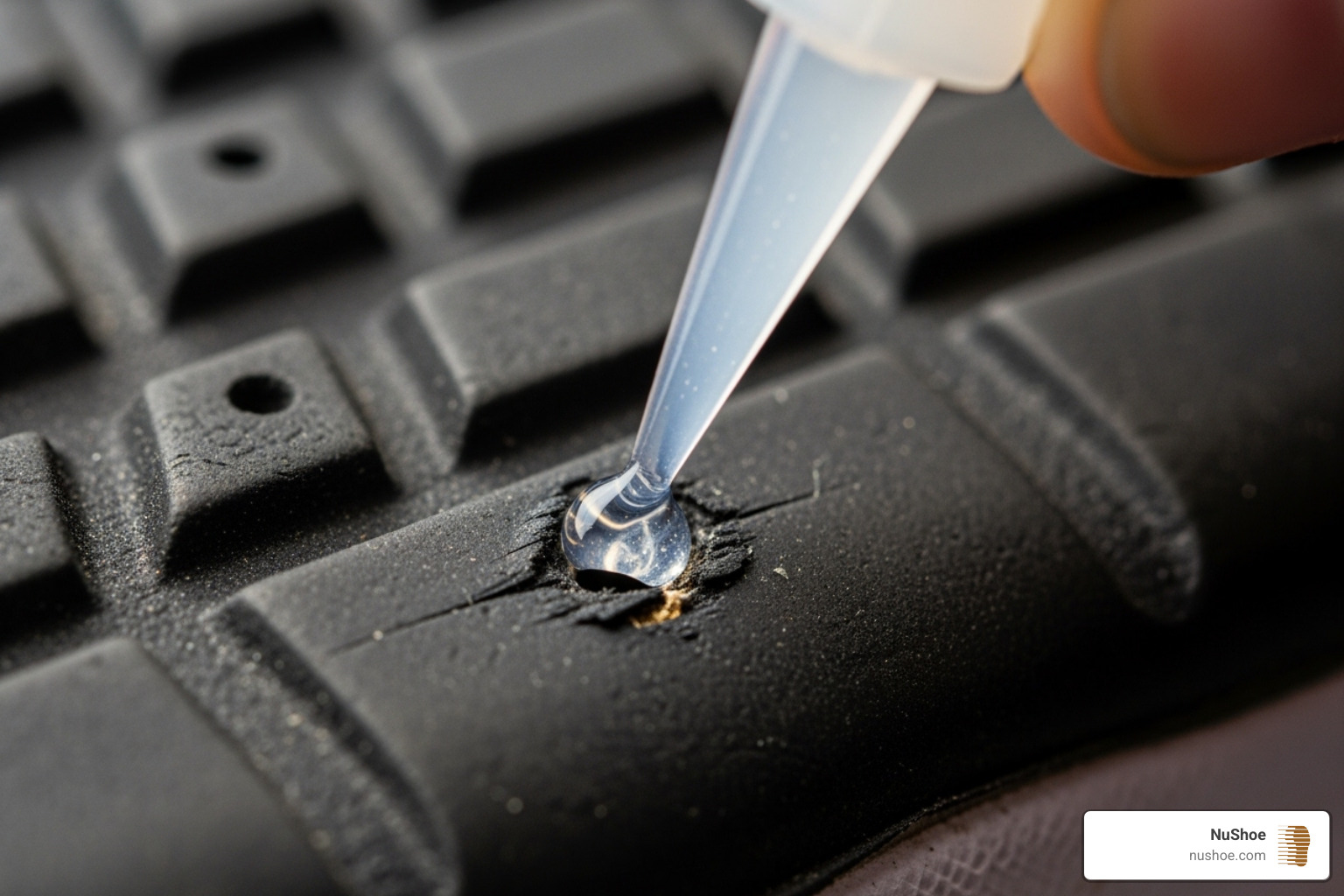
Filling cracks requires working the adhesive deep into the damaged area. Use a cotton swab or small tool to ensure the flexible shoe repair adhesive gets into every crevice. For filling punctures, be generous with your shoe repair filler or Shoe Goo – overfill slightly since some adhesives shrink as they cure.
The smoothing step separates amateur repairs from professional-looking results. Here’s an old cobbler trick that works beautifully: use an ice cube or a tool covered in petroleum jelly to gently smooth wet adhesive without it sticking to your tool. Wipe away excess immediately while everything’s still workable.
Let your repair cure sole-side up for a full 24 hours. Once dry, you can gently sand any overflow adhesive for a cleaner finish. For larger punctures, consider applying a rubber patch over the filled area for extra durability – it’s like adding a bandage over a bandage.
Frequently Asked Questions about Replacing a Shoe Sole
After helping customers restore their favorite footwear for nearly three decades, we’ve heard just about every question you can imagine about replacing shoe sole components. Let me share the most common concerns that come up when people are deciding whether their beloved shoes deserve a second chance.
Is it worth it to repair shoe soles?
This is hands down the question we get asked most often, and my answer is always enthusiastic: absolutely! From our experience breathing new life into over 5 million pairs of shoes since 1994, I can tell you that replacing shoe sole components is one of the smartest investments you can make for your footwear.
The money savings alone are compelling. A professional sole replacement typically runs between $35 and $150, depending on your shoe type and the materials needed. Compare that to buying new quality footwear, which can easily cost anywhere from $100 to $500 or more. Those beloved work boots with Vibram soles? We can replace those soles for $80 to $150, giving you many more years of reliable wear.
Then there’s the environmental angle, which frankly gets me excited every time I think about it. Every shoe we repair is one less pair heading to a landfill. Manufacturing new shoes consumes significant resources and energy, so choosing repair means you’re actively participating in a circular economy. It’s a choice that makes a real difference.
Don’t underestimate the sentimental factor either. Some shoes just can’t be replaced – maybe they’re perfectly broken in, hold special memories, or took months to find in just the right size. When the upper leather is still supple, the stitching remains intact, and the fit is perfect, replacing shoe sole components lets you keep those irreplaceable favorites.
The key question to ask yourself is simple: if everything above the sole is still in good shape, why throw away a perfectly good shoe? The sole wears out first because it takes the brunt of every step, but it’s also the most replaceable part of quality footwear.
What is the best glue for replacing shoe sole parts?
Ah, the eternal adhesive debate! After decades of working with every type of shoe repair adhesive imaginable, I can tell you there’s no single “best” glue for every situation. The right choice depends on what type of repair you’re tackling and how your shoes will be used.
Shoe Goo remains the DIY favorite for good reason. It’s incredibly versatile, stays flexible after curing, and creates a waterproof bond that can handle the constant flexing that shoes endure. It’s perfect for filling cracks, reattaching small sections, and general wear repairs. Plus, it dries clear, so minor imperfections won’t be obvious.
For heavy-duty repairs, E6000 is hard to beat. This industrial-strength adhesive creates an incredibly durable bond while maintaining flexibility. It handles extreme temperatures well and provides excellent waterproofing. When customers have larger detachments or need something that will hold up to serious abuse, this is often our recommendation.
Contact cement is the professional’s choice for full sole reattachments. You apply it to both surfaces, wait for it to become tacky, then press them together for an instant, incredibly strong bond. The catch? You get one shot at alignment because once those surfaces touch, they’re bonded permanently. It requires precision but delivers professional results.
When waterproofing is critical, particularly for hiking boots or work shoes that face wet conditions regularly, Aquaseal SR shines. It creates a clear, abrasion-resistant seal that’s both flexible and completely waterproof.
The most important factor isn’t which brand you choose – it’s following the instructions properly. Always clean and roughen surfaces before applying any adhesive, and give it the full recommended curing time. Most adhesives need at least 24 hours to reach their full strength, even if they feel dry sooner.
Can any shoe be resoled?
I wish I could tell you that every shoe can be given new life, but the honest answer depends entirely on how your shoes were originally constructed. Think of it like asking whether any building can have its roof replaced – it depends on how it was built.
Goodyear-welted shoes are the resoling champions. These beauties – which include most high-quality dress shoes, many work boots, and traditional hiking boots – were designed with repair in mind. The upper is stitched to a leather or rubber welt, which is then stitched to the sole. This construction lets us remove the old sole cleanly without damaging the upper, making resoling straightforward and repeatable. Some of our customers have had the same pair of boots resoled four or five times over decades.
Cemented construction shoes present more of a challenge but aren’t impossible. Most modern sneakers and casual shoes use this method, where the upper is glued directly to the sole. We can often work with these, carefully removing the old sole and applying a new one with professional-grade adhesives. The success depends on the quality of the upper and how well the original sole comes off. Quality sneakers with leather or sturdy fabric uppers often make good candidates.
Molded soles are the tricky ones. Some athletic shoes have soles that are molded directly onto the upper during manufacturing, creating a seamless but permanent bond. These complex, multi-component sole units weren’t designed for traditional resoling, though creative repairs are sometimes possible.
Here’s a simple way to assess your shoes: look at where the sole meets the upper. If you see visible stitching around the perimeter, especially thick, prominent stitches, you likely have a welted shoe that’s perfect for resoling. If the join looks smooth and seamless, it’s probably cemented construction.
When you’re unsure, don’t hesitate to reach out to us. We can assess your footwear and give you honest advice about whether replacing shoe sole components makes sense, or if there are other repair options that might extend their life. Sometimes even shoes that can’t be fully resoled can benefit from protective sole covers or targeted repairs to specific worn areas.
Conclusion: Give Your Footwear a Second Life
The journey of replacing shoe sole components is really about giving your favorite footwear the second chance it deserves. Whether you’ve tackled a DIY repair with some Shoe Goo and rubber bands, or you’re considering our professional handcrafted renewal services, you’ve taken a meaningful step toward sustainability and smart spending.
Every time you choose repair over replacement, you’re making a difference. You’re saving money – often hundreds of dollars compared to buying new quality footwear. You’re reducing environmental impact by keeping perfectly good shoes out of landfills and reducing the demand for new manufacturing. And you’re restoring beloved shoes that have walked with you through countless adventures, preserving their comfort and the memories they hold.
At NuShoe, we’ve seen the change that happens when worn-out footwear gets expert attention. Since 1994, we’ve restored over 5 million pairs of shoes and boots, turning tired soles into reliable companions ready for many more miles. Our handcrafted renewal process doesn’t just fix your shoes – it often makes them feel better than when they were new.
The beauty of sole replacement lies in its simplicity: most quality footwear outlasts its original soles by years, sometimes decades. That’s why we’re passionate about what we do. Your favorite hiking boots, work boots, or dress shoes don’t need to end their story just because the soles have worn thin.
Ready to give your footwear that second life? Learn more about our expert boot sole replacement services and find how we can help you keep your favorite boots and shoes walking for years to come. After all, the best shoes are the ones that have already proven they belong in your life.